

The Development of Microfinance Institutions in a Multi-Tier Framework

Microfinance industry has achieved an unprecedented growth over the last two decades. Consequently, the landscape of the microfinance institutions (MFIs) has evolved to include a diverse array of institutional types. As a result of this increasing diversity, several classifications of MFIs based on performance and institutional set-up emerged to address the needs of donors and investors. Today, definitions that classify MFIs into tiers based on several dimensions that include size, maturity and sustainability are increasingly used by practitioners and researchers. The first part of this thesis presents the widely accepted tiered classifications of MFIs. The second part of the thesis analyzes the institutional development of six top-tier MFIs by investigating the changes in ownership, governance and human resources management across tiers. Finally, the thesis explores the commonalities and distinctive patterns in MFIs that advanced tiers over time, by examining the speed of growth, capital structure and performance.

Author image

oikos International

posted July 6, 2016

This might be for you.

The Pluralistic Economics Movement as Done by oikos Leipzig

What is economics and how to get a better grasp at this area of knowledge? That’s the big question some student initiatives try to answer in Germany. Economics students all around the country question the way economics is taught at university. Indeed, almost all the lectures take a neo-classical approach, leaving aside the plurality of theories which appeared during the last decades. The movement started in 2003 in Germany with a working group followed by the creation of a pluralist economics association in 2007, whose name was changed into “Netzwerk Plurale Ökonomik” in 2012.

oikos Leipzig has been part of this movement for several years now, through the working group AK Plurale Ökonomik. AK Plurale Ökonomik is an independent group which not only organizes biweekly reading circles to talk about recent research on that subject, but also events at university with distinguished guests. The latter are highly successful among students and beyond. The working group also tackles the issue of the lack of input of actual topics in the teaching model, like the euro and financial crisis, the growing income and wealth inequalities or even the degrowth-movement.

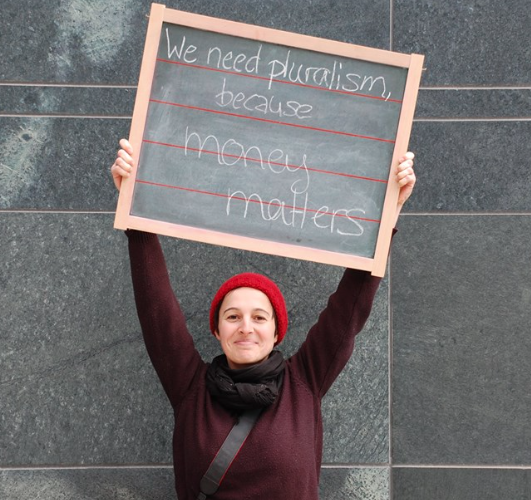
In May 2014, a similar community was created with active members all around the world: ISIPE, International Student Initiative for Pluralism in Economics. oikos Leipzig is also part of it and participated in the global action day #2 on the 2nd of May. This event is a way to show the world that students care about getting other views in economics. Therefore, the AK Plurale Ökonomik decided to take pictures of students holding a placard with the sentence: “We need pluralism, because…”. Everyone was encouraged to say why pluralism in economics is important to her / him. You can see the pictures on the oikos facebook website.

But if we talk about pluralism, shouldn’t be the question “what are economics?”

Do you want to know more about the Netzwerk Plurale Ökonomik or about ISIPE? You can visit their websites and take look at the open letter of ISIPE.

https://www.plurale-oekonomik.de/home/

Written by Tiphaine Roualt, oikos Leipzig 

Author image

oikos International

posted May 30, 2016

This might be for you.

Reading Circle on Pluralistic Economics: Do I Need to Save to be Able to Invest?

oikos Leipzig hosts its bi-weekly reading circle on pluralistic economics. Further information (in German) is available here.

Author image

oikos International

posted May 13, 2016

This might be for you.

Reading Circle on Pluralistic Economics: Welfare Indicators, Happiness and Post-Growth

oikos Leipzig hosts its bi-weekly reading circle on pluralistic economics. Further information (in German) is available here.

Author image

oikos International

posted May 13, 2016

This might be for you.

Reading Circle on Pluralistic Economics: Are the Answers to be Found in Data? A Critical Review of Econometrics

oikos Leipzig hosts its bi-weekly reading circle on pluralistic economics. Further information (in German) is available here.

Author image

oikos International

posted May 13, 2016

This might be for you.

Model WTO

oikos Baku is organizing their first Model WTO in partnership with the UNEC Model UN. Two working groups will engage in the simulation: a country working group on Azerbaijan’s accession negotiations; and a building trade capacity group on the challenges of global trading system.

Find more information here.

Author image

oikos International

posted May 11, 2016

This might be for you.

How do innovative banking channels reduce costs in downscaling?

This paper analyzes and quantifies cost structures of agent-assisted banking beyond branches channels (ABCs) and compares them to the costs of branch channels. This addresses a gap in the existing literature. The qualitative review finds that ABCs maximize the proportion of variable costs that depend on realized transactions, which match revenue flows. ABCs reduce investment and operating costs, since existing agent business infrastructure is enhanced and shared. In the context of downscaling, ABCs bridge the major barrier for commercial banks: the expensive last mile to the customer. The quantitative review finds that POS / PC terminal-based ABCs reduce transactional costs to 58 percent of branch channel costs and mobile-based ABCs to 15 percent. Apart from analysis and quantification of cost structures, this paper develops a comprehensive definition of ABCs. Likewise, downscaling is defined; the two research fields are linked and investigated from a commercial banking perspective. This addresses gaps in the existing literature.

Author image

oikos International

posted April 26, 2016

This might be for you.

oikos FutureLab 2016

The oikos FutureLab is the biggest event in the annual oikos calendar which gathers representatives from the entire oikos community. It provides a 2-day platform for 140 participants to inspire, discover and develop joint perspectives on the future of sustainability in management and economics. More information is available here.

Author image

oikos International

posted April 22, 2016

This might be for you.

CSR and Human Rights Under the Light of a Game Theory Approach

The thesis will demonstrate Bilancini and Boncinelli (2014)’s model of two players with a signal-sending player making an offer of two types, namely high quality and low quality, and sending either high or low signal on the offer; and the signal-receiving player who perceives and processes the signal in either of two elaboration levels, namely high elaboration or low elaboration with the emergence of coarse thinking. Different strategic and psychological behaviors result in expected utilities that define equilibrium states. The game proves to be a suitable model to explain Giuliani (2014)’s definition of low-road, window-dressing and rights-oriented clusters as per CSR adoption and human rights practice. The concept of window-dressing cluster/firm will be analyzed under the model with regard to the reverse-signaling phenomenon where a low quality player sends high signal and vice versa which is compatible with the silent CSR cluster/firm concept.

Author image

oikos International

posted March 22, 2016

This might be for you.

One Member’s Experience in the oikos Economics Learning Circle

At the FutureLab 2015 I attended the learning circle Economics, which was coordinated by Moritz Linder. The sessions were about how to get more pluralism in the monotone and mainstream sciences of economics, so that students and professors get another view on how to teach and research on certain issues and matters and start thinking out of the box.

In the first session we learned about different movements of pluralism and where we can inform ourselves if we want to get more involved and to start something at our own universities. If you are interested in this topic, please check out following: Peps Èconomie (France), Netzwerk Plurale Ökonomie (German speaking countries), Rethinking Economics (International), JEC group (Argentina) and ISIPE (international).

After learning about these, the discussion focused on how to define economics. This discussion was on the one hand very interesting because you heard a lot of different opinions. But on the other hand it was complicated because it was easy to lose track of the main issue and to drift in abstract spheres, which had little to do with economics. Never the less, one point we all agreed on was that economics are not a natural science, where you can reproduce the solutions over and over again. But they are a social science, which heavily depends on the assumptions and parameters of the theories.

The second session we made four groups, where each group read a different paper and later gave a brief summary about the topic. All of the four papers gave a different/heterodox view on neoclassical topics:

• “The rebound effect unravelled” by Tilman Santarius
• “Reflections—defining and measuring sustainability” by Geoffrey Heal
• “Changing visons of humans‘ place in the world and the need for an ecological economics” by Robert Costanza
• “Natural capital and sustainable development” by Robert Costanza and Herman E. Daily

Every single one of these showed an exciting, new look on existing mainstream point of views. I want to give you a quick overview on the rebound effect, as I think this is the most interesting topic of the four. The rebound effect means that despite the fact that our technology and world gets more and more efficient, we use more resources as e.g. 100 years ago. By resources I mean, energy, fuel or your own time. A short example will clear this up: our cars get faster and faster, so we are able to travel a much larger distance in a shorter period of time, but we still travel one hour to get e.g. to work. So we have not saved any time, despite our faster cars. Another good example is that when we produce a solar plant we can save oil. But in the making process we waste so much other materials and after use these plants cannot easily be disposed, which is also a waste of resources. There are tons of other examples.

The last session was about how we can bring pluralism and heterodox economics to our universities and curriculums and we had a kind of wrap up about what we learned in the past two days. There were a lot of great ideas on how you can make education matter:

• Make a workshop about pluralism
• Establish a reading circle about certain heterodox topics
• Ask professors from other universities to give a lecture at your university
• Get in touch with the above mentioned movements and see if you can make an event or if there is an event near you
• Work with, not against your professors if you want to establish a lecture or a whole course about heterodox economics

To give a short summary about the whole circle, I have to say that I have learned a lot. Not only because we read papers which do not have a mainstream thinking, but also because there were so many different and brilliant discussions and thoughts. Hope the next FutureLab will also be that interesting!

Cheers,

Christoph

This article was taken from the oikos Vienna Blog. The testimony can, likewise be found here: http://oikosvienna-blog.com/2015/11/13/learning-circle-economics-futurelab-2015/ 

Author image

oikos International

posted November 23, 2015

This might be for you.